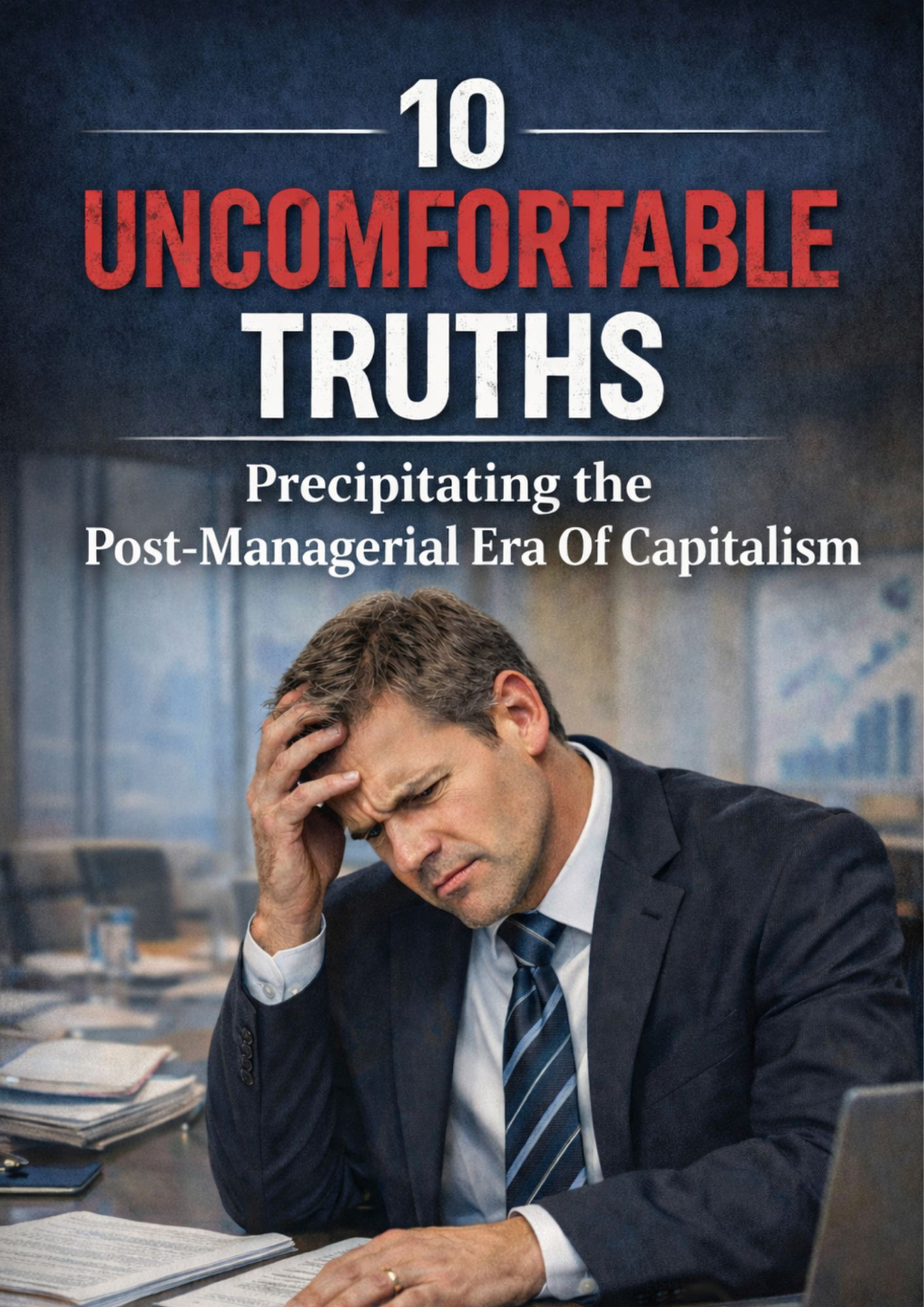
Uncomfortable Truths Precipitating the Post-Managerial Era of Capitalism
Why the foundational assumptions of management science and MBA orthodoxy no longer explain performance, coordination, or value creation.
Management as we know it was built for a world of stability, predictability, and control.
That world no longer exists.
Yet most organizations continue to rely on planning, hierarchy, incentives, and managerial oversight as if they still worked. The result is not better performance — it is coordination theater, false productivity, and organizational fragility.
This paper argues that we are entering the Post-Managerial Era of Capitalism.
Not because leadership is obsolete, but because management as a discipline — built on linear causality, rational actors, and centralized control — is increasingly misaligned with how complex systems actually behave.
Inside, we examine ten uncomfortable truths most leaders already sense but rarely articulate:
- Performance is shaped by context and system design, not managerial control
- Much management work exists to justify itself rather than create value
- Planning often explains outcomes after they emerge
- Hierarchies delay and distort intelligence
- Incentives corrupt behavior as often as they motivate it
- “Best practices” fail in complex environments
- Leadership emerges from relevance, not position
- Promotion systems favor compliance over capability
- Human behavior is emotional, biased, and identity-driven
- Value creation increasingly occurs outside the firm
Clinging to outdated management logic produces fake productivity, innovation theater, disengagement, and fragile organizations — while leaders are blamed for failures created by obsolete systems.
Download Now
This paper introduces the core thesis developed fully in the book The Post Managerial Era Of Capitalism (Cambridge University Press).
The Post Managerial Era Of Capitalism provides the theoretical underpinnings of the epic shift away from management. A subsequent book, Venture Mode, will advance beyond critique and into the new practices that will replace managerial capitalism.